

On Wisconsin Public Radio’s Here on Earth program — moderated by the able Jean Feraca — Gene Kannenberg and I chat about Tintin and field listeners’ calls; you can find a streaming of the show at this link.
Enjoy my dulcet tones– or, rather, my robotic stammer.
———————————————
Some have chided me for overlooking the most excluded of “others” in the Tintin oeuvre, i.e. women.
This is indeed true. In all the albums, there are only three or four women with so much as speaking roles. I interpret this as a hangover from the fiercely puritanical Catholicism of Hergé‘s youth, mixed with his own dose of misogyny. Hergé’s own explanation fails to convince:
“True, there are only a few women, but not out of misogyny. No, it’s simply because as far as I’m concerned, women don’t belong in a world such as Tintin’s; it’s one dominated by male friendship, and there is nothing ambiguous about such friendship! Of course there are only a few women in my stories and when they do appear, they are caricatures, such as Castafiore.
If I were to create a character who was a pretty girl, what would she do in a world where all the other characters are caricatures? I love women too much to turn them into caricatures!
Anyway, pretty or not, young or not, women are rarely comical elements.
Would it be the maternal side of women which prevents us from making fun of them?”
(That last sentence would be of interest to a psychiatrist…and, indeed, Hergé spent years in analysis.)
But there is one woman in Tintin with enough force and character to dominate any story she shows up in; yes, the divine ‘Nightingale of Milan’, the Empress of the Opera:
Bianca Castafiore!

What mere male can fail to wilt before such beauty and power?

As the good Captain Haddock says, a formidable woman.
Ah, Captain, submit to the inevitable; the charm and might of La Castafiore will keep you in her thrall!

The transition from ogress to goddess is most satisfying, and is consummated in Hergé’s wittiest Tintin album, Les Bijoux de la Castafiore (‘The Castafiore Emeralds’)
Love her though I do, I must concede that the Castafiore is a monstrous caricature of woman.
What I delight in, however, is the way she serenely floats above every catastrophe…even when on trial for her life (in “Tintin et les Picaros”) she turns the courtroom into an opera stage!

You go, girl!
————————————–
Tintin wasn’t Hergé’s only series.
One may applaud the cosmopolitanism of the later Tintin albums (and of the redacted earlier work), yet still regret a certain earthy malice inherent to the initial work: Tintin was, in the beginning, a brawling, cunning trickster more than a boy scout. He was also definitely Belgian, as contrasted with the somewhat bland “international” Tintin of later years.
As a counterpoint, I recommend (to you who speak French) the series of albums featuring Quick & Flupke, a pair of wicked little Brussels street urchins.

The Belgian equivalents of the Katzenjammer kids or of Max and Moritz, these two lively pests were well grounded in the rich culture of that teeming capital, Brussels.
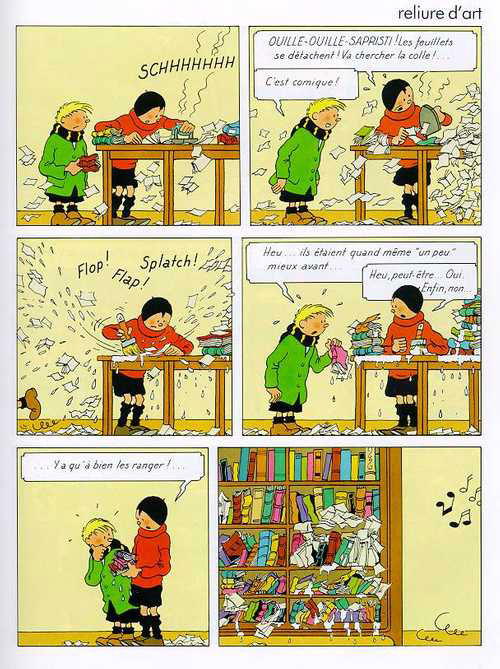
The series, composed of two-page stand-alone gags, also lets Hergé indulge one of his major talents as an entertainer– the gagman… but in a childlike, gentle mode that didn’t exclude mild satire:


And the establishment– represented by the police– comes in for some tweaking at the hands of this delinquent duo:

Try this strip some time!
oh wow, Quick & Flupke are adorable. How does he make eyes that expressive when they’re essentially just dots?! Brilliant.
Caro:
The “secret” is simple: you can’t perceive the dots in isolation, they function in accordance with what’s around them. In color theory this happens in the simultaneous contrast.
Since I mentioned color: those three last examples are a lot poorer than the others. It’s a bad case of recoloring, I suppose?
I am really enjoying this series of posts on Tintin, and the first half of this one reminded me to pull back out Frederic Tuten’s novel Tintin in the New World, in which Tuten explores specifically the role of women in Herge’s world and, in particular, Tintin’s rather sexless, perpetually adolescent existence. It’s a great postmodern read.
Hmm, I’ve come to the conclusion that Tintin is really an androgyne; certainly, many girls have told me that they readily identified with him. I think cunning old Hergé delibertely “ephebised” him in his avowed intent to make Tintin a blank slate.
Love her though I do, I must concede that the Castafiore is a monstrous caricature of woman. What I like, however, is the way she serenely floats above every catastrophe…even on trial for her life (in “Tintin et les Picaros”) she turns the courtroom into an opera stage! You go, girl!
BTW, Hergé had — at least in his youth — the petty bourgeois’ dislike of “highfalutin'” culture. The satire of Castafiore has its class element…
Huh, I’ve written stuff in comments I should’ve put in the post. I’ll fix that.
BTW, I’ve added extra visual material to the older ‘Tintin’ posts, so those of you kind enough to have read them might check them out again.
Finally, on ‘Quick & Flupke’: Hergé refused to allow new Tintin material to be published after his death (much to the sorrow of his main assistant, Bob De Moor, who’d been looking forward to this as a reward for his decades of service).
However, Hergé wasn’t nearly as possessive about Quick & Flupke, and new episodes still come out from Studio Hergé.
Isn’t it pretty widely held that Castafiore was meant to be a stand-in for Hergé’s first wife? Relevant considering ‘The Castafiore Emeralds’ came out post-divorce. After a recent trip to the Museum it was nice to she gets a shout-out in a display case.
Also, Mr. Buchet, I must say that these posts are really wonderful. I would love to get a chance to talk to you more about the “Others In Tintin” more broadly, especially because I have a research grant to explore that very topic. I’m currently in Brussels and am not resourceful enough to find another way to contact you (e-mail, etc.). So let me know if you would be interested in a conversation!
Sure! Thanks for the kind words, Nadim. I live in Paris. Write to me at:
Alexandre Buchet
37 Rue de Constantinople
Paris 8ème
France
…or look me up on Facebook. Careful, I’m there as Alex Buchet, there’s a homonymous Alexandre Buchet in Belgium.
And call me ‘Alex’, not Mr Buchet.
Alex, this was a really interesting, enlightening series of posts on Tintin – great reading!
Thanks, Sam. There may be more to come!
There was an attempt to add another female character: Martine in Alph-Art. There are rumors that Herge if finally giving Tintin a love interest with Martine…
Indeed there is another Alexandre Buchet and fan of comics too… ;-)
Mr Buchet but call me Alexandre :-p
Hmm! maybe we can commit crimes and alibi each other, Alexandre!
Yes, I saw once that you were into comics…I was googling my name and found you!
— Alex
I would like to discuss the legacy of my childhood French hero TinTin?? We all loved this young character with his semi bald head only with few spiky hairs on top of his forehead?! I used to cry day N night ..asking my Mum to buy me one of his French hard covered comic books , she pleaded with my older cousins ,they tried but not to avail? !as it wasn t available in all BEIRUT s bookshops then, and the limited quantity was expired by then , so instead i ve got French version of Mickey Mouse & the magic lantern book! just to keep me quiet for sometime? My Armenian school /classmates some got hold of few adventure books of TinTin and we used to lend and pass it around ,i was awestruck by his adventures in Le Temple du Soleil ? or Temple of the SUN! BUT we done all this in secret ,as we were not allowed to read such books during our breaks ..so it was Hush Hush business. Also in those good old days in LEBANON as kids we had a weekly Arabic comic book called S A M I R or SAMEER ?, which was(even if not in our Armenian language) but as we were learning the country s spoken tongue IT helped!.Even though at the time there were many other Arab comics on sale such as S I N D I B A D /also from Egypt like SAMIR ! then Dunia Al Ahdath meaning (Children s World!)& Z A R Z O U R meaning The Starling bird, Actually Sindibad mag. had (1) page character inspired by TinTin with single haired boy called ZOU ZOU, very Funny chap ! By April 1958 1st Pilot edition of Arabic Micky was on sale in the Arab world Monthly /by Jan. 1962 it turned into a weekly, & on every Thursday? My gratitude to such publications is IMMENSE , , as reading them improved my Arabic Language , be it spoken/written and AS an ARMENIAN and .. i declare this very humbly but very pleased and honored by it ! In August 1959 , i was then 11/12 Y.O.boy .my late Mum and I went to ISTANBUL/TURKEY , as after 35 years and also after very Excruciating trials my mum found her Missing sister alive there,so we had long journey on CARS/BUSES/ TRAINS/BOATS but no planes! In Istanbul my dreams came true, i bought my first Turkish TinTin a weekly comic book and because my parents at home spoke Turkish,between now N then, and as i can read the Latin Alphabet only Turkish s/c letters confused me for sometime , even i collected other books such as PEKOS BILL/TOPAZ/ 1001 nights or in Turkish (GECELER) read GEJELER )etc..etc even worked in a local book shop in there just to be surrounded by such books..and i, suppose to be on holiday?? ONLY by 6th of August 1961 our beloved SAMIR weekly began to serialize TinTin s adventures in Arab desert or The Crab in Princes Gold in 2 sometimes 3 pages weekly, that s How THE Red Carpet was laid for TinTin in Arabia,only by mid sixties complete TinTin books published by DAR EL MAARIF in Egypt & were on sale . i Just remembered this, actually in 1956/7 and in one of Beirut s famous streets GEORGE PICOT and next to the city s downtown 1st skyscraper S T A R C O , There was a shop that sold all TinTin books and relics..& souvenirs , i assume the owner was a Jew then, as the area was in the Jewish quarter of Beirut?? also i do recall another such shop opened at Kantary..close to the famous Holiday Inn Hotel ,next to a famous Supermarket A Z I Z .. then,,was next to it?? still in the same quarters.. coincidence?? Also few other Arabic comics such as AL KATKOUT meaning >>> the Chick, tried to copy pages from TinTin ,but we ALL loved HERGE and his BABYBOY ..NO DOUBT! Regards From IS-HAK Barsoumian/London U.K
!