
More than 15 years after its initial debut in Japan, and just about 10 years since its debut in America, the Bishoujo Senshi Sailor Moon manga is making a comeback, with a brand new edition in English from Kodansha, Pretty Guardian Sailor Moon.
Of course there are many fans that are thrilled by this – I count myself among them. For those of us who love this series, no explanation, no reasons, no critical analysis need be applied to the series. We love it, full stop.
However, the refrain I’m hearing over and over from those people who did not catch the wave the first time around, is “I don’t “get” it. What’s the big deal?”
First of all, let me disabuse you of the notion that there is a Big DealTM about Sailor Moon. There isn’t. If you don’t like it, don’t “get” it, can’t understand what we’re seeing, you’re not missing anything critical. Let’s be honest here – if you think Usagi is annoying, and don’t like the premise, the clothes, the romance…there’s nothing I can say to change your opinion. You don’t like Sailor Moon. Own it. I don’t like Dragonball Z and nothing any one of the zillions of fans is ever going to say will change my opinion.
So…what is the big deal about Sailor Moon? Let me tell you my story.
I used to collect American comics. I still have long boxes full of Avengers, Defenders and Invaders. But honestly, by the late 80s my interest was waning. Janet hadn’t killed her asshole husband Hank yet and the Valkyrie still wasn’t lesbian, even though she obviously was. There were fewer and fewer good female characters. When Storm joined the Avengers, and the Legion of Superheroes couldn’t tell that Quisling was the traitor among them, I knew I was done. Although I stopped collecting, I didn’t get all anti-comics. I just left comics and stopped filling the longboxes. I kind of missed the stories, but not enough to go back. Indie comics were too full of themselves (and had no women either) so I just…stopped.
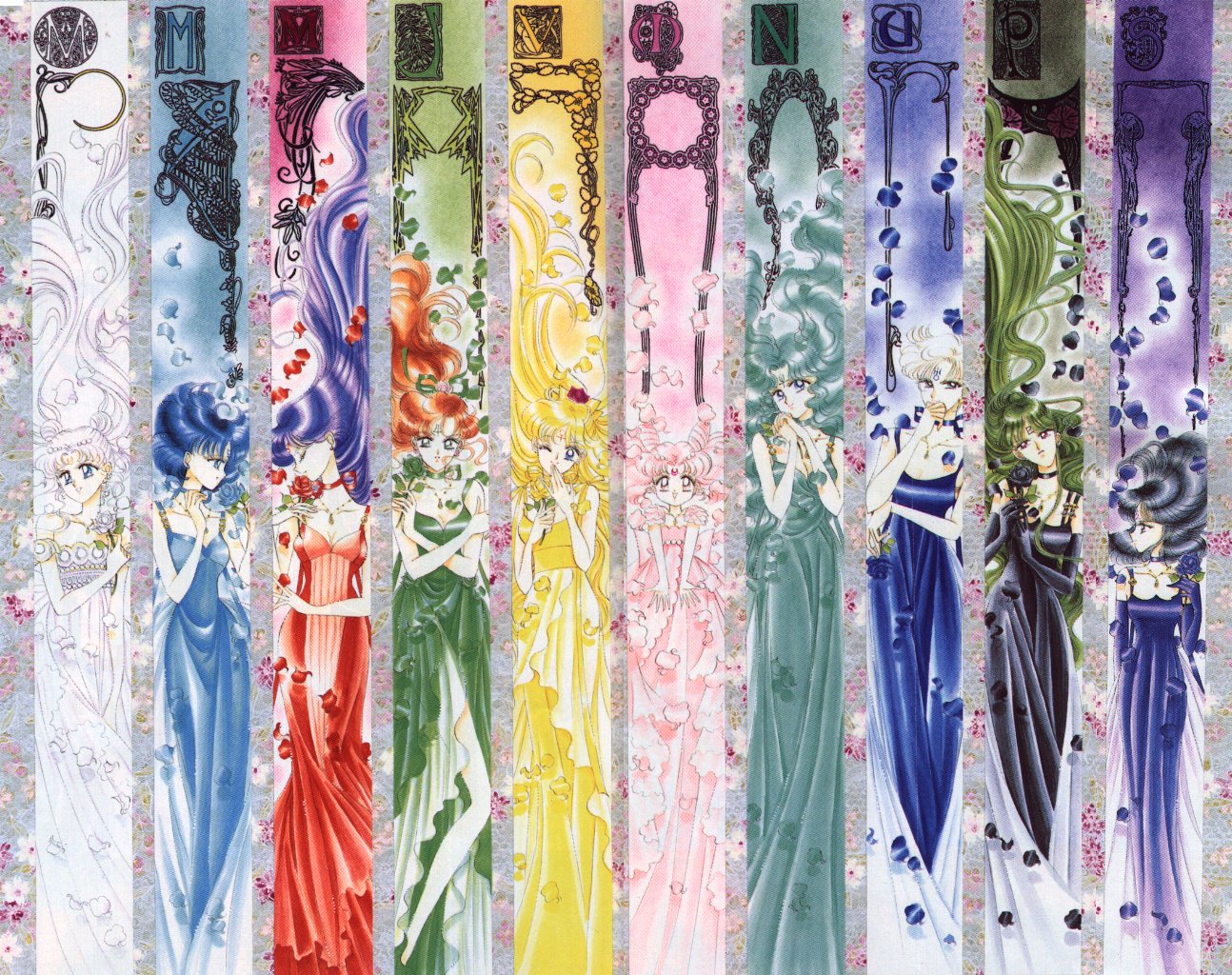
In the late 1990s, anime and manga were starting to become popular here in the US. Cartoon Network used power anime series Dragonball Z and Sailor Moon to spearhead an afternoon anime block. It broke all records for animation in America.
I knew of it, of course. By then I was already making tentative steps into derivative fan work, with some fanfic of Xena: Warrior Princess and, for the first time in many years, found my interest in comics returning…only this time, it was all about manga. Friends came to the house with anime; we watched popular series like Ranma 1/2 and Tenchi Muyo and it was all laughs and fun and games.
So when my wife was home unemployed, and she started watching this series on TV called Sailor Moon, I wasn’t all that surprised that we liked it. I’ve told this story many times, that the first episode I watched was titled in English “Cruise Blues” and when Amy asked Ray if she noticed that they were the only ones on the ship without boyfriends and Ray replied that they didn’t need boys to have fun, I turned to my wife and said, “We are watching two different cartoons. You are watching the pre-pubescent little girl cartoon and I am watching the one with tremendous lesbian subtext.” And so, we were both hooked.
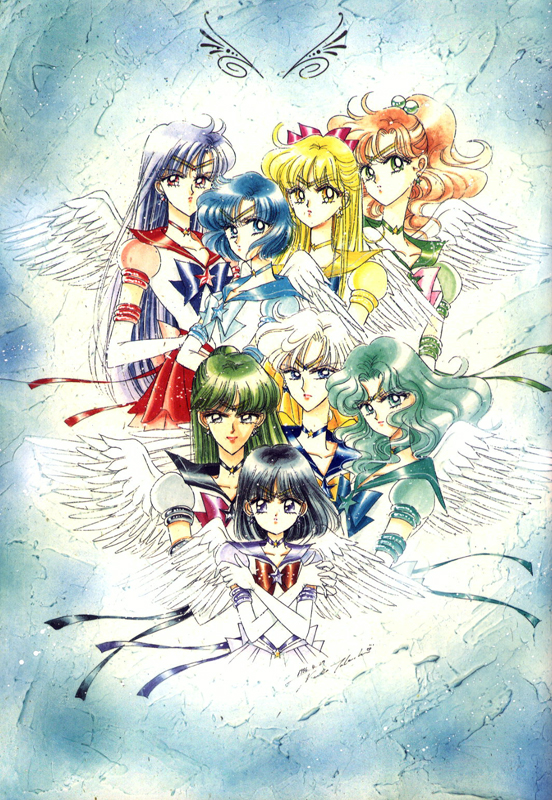
I started to research this Sailor Moon and instantly encountered the fact that two of the Sailor Senshi were a lesbian couple (and this outside of the not subtle lesbian subtext between Usagi and Rei, Minako and Makoto, later Ami and Makoto, and in the manga Minako and Usagi and Rei and Minako. It was actually kind of hard to avoid it, unless you worked hard at it.) And then there was the obvious, incestuous triangle of Usagi, Mamoru and Chibi-Usa. And that was only in the first two series!
Once I learned about the third season, the appearance of the “Outer Senshi” and the fact that they had what was as close to an out lesbian couple as I’d ever see in anime (this was back in the late 90s, remember,) I dug around until I found fansubs of the series. Fansubs weren’t easy back then. You mailed a blank VHS plus postage to some guy somewhere and he sent you back a VHS with a nth generation copy with subtitles manually entered and timed. If you were lucky, the guy was making copies from an LCD.
That’s how I discovered Sailor Moon Super or Sailor Moon S, as most people call it. And how I discovered Sailors Uranus and Neptune, who are indeed a fabulous lesbian couple.
As my wife and I watched Sailor Moon S in Japanese, I realized I could parse some of the linguistic patterns and since I really, really wanted to read the manga for this series (it was still years before Tokyopop would consider putting it out) I started to learn Japanese…just to be able to read Sailor Moon.
The manga was pretty sketchily drawn. Takeuchi’s feet and hands are not worthy of praise. But her characters are beautiful. Yes, they all have the same face…there’s darn few manga artists that don’t do a find and replace face. That’s exactly why hair styles and colors are so strange in shoujo and shounen manga – because otherwise all the characters have the same features. And yet, those lines are lovely, feminine and appealing. Takeuchi wasn’t afraid to dress her characters up, or play a little with their personalities.
The plot is…childish. A slightly-below average middle schooler is the leader of a group of “Guardians” from an ancient Moon Kingdom? Well, gosh that makes tons of sense, doesn’t it? I have two words for you – Dragonball Z. The plot doesn’t have to be sensible, any more than Cinderella’s fairy godmother giving her a glass slipper does. Sailor Moon is childish because it’s written for children. For girl children who want to be Princesses who fight for love and justice and who get the guy, but get to rule the Queendom, rather than adorn the King’s arm. Not for nothing is Queen Serenity accompanied by Prince Endymion. But all the characters were, at heart, girls that any girl might identify with. Girls who are a little – or a lot – different. Each Senshi reflects an archetype, a zodiac. Each Senshi reflects us.
So what is the big deal?
It was a series for girls, when little to no series took girls seriously. Like Xena, Usagi fought for good. Like Xena, Usagi gathered around her allies and enemies. Like Xena, Usagi’s allies become more than just friends. Unlike Xena, Usagi was just a regular girl. Perhaps it was the zeitgeist but for me, having Xena and Gabriel on TV paved the way for me to love cool, attractive Junior Racer Haruka and genius violinist Michiru. The anime fed into the manga, which fed back into the anime. Character qualities and experiences spilling from one into the other and back created a body of canon, fed by the deep well of fanon in the form of fan art and fanfic (many dozens of which I wrote and still ocassionally write) that created the spring with which our fandom was irrigated.
I don’t know if anyone coming to Sailor Moon now can feel that, but I do know it’s been on the New York Times Best Seller list since Volume 1 was released. I’m not surprised at all. Usagi is still annoying yet lovable, Ami is still admirable and sweet. Makoto is strong, yet feminine. Minako, when she arrives will be goofy, but a staunch leader. Setsuna will be mature and mysterious, Chibi-Usa will be 10x annoying, but sympathetic, Haruka and Michiru will be talented, cool, and deeply, obviously in love. And last, but almost never least, Hotaru will be pitiable and amazing.
What’s the big deal about Sailor Moon?
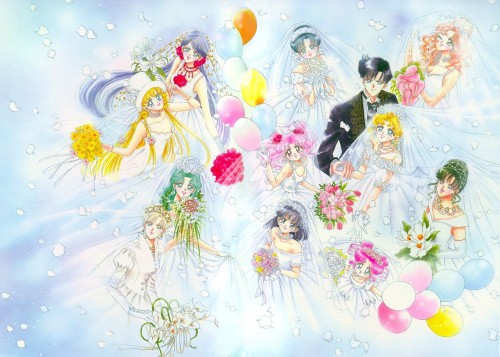
You tell me.
I love that first image; psychedelic sugar rush.
This piece is interesting coming right after Nate’s. It seems that, like him, you’re saying that in part the point of the comic is the community it creates. The big deal about Sailor Moon is partially that it was so formative of shojo in the U.S. and of a female manga American readership.
Absolutely, and part of that was that the characters were so relatable (on purpose) so that there’s someone for everyone to care about.
There was a zeitgeist that Sailor Moon was part of – that’s absolutely unrevisitable. But the essential princess fairy tail with pretty, feminine, art remains.
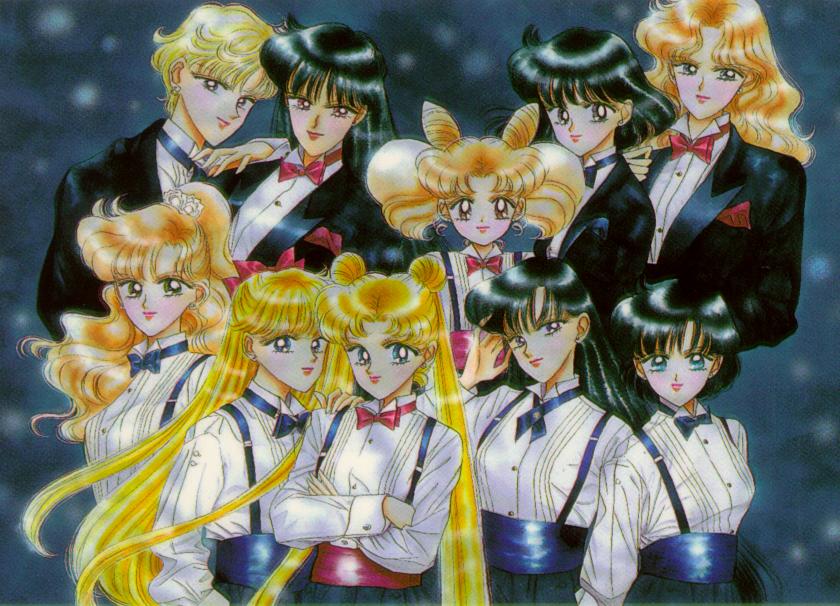
I chose the poster art to illustrate this article because it embodies both zeitgeist and pretty art at once. I have the poster of the Senshi in tuxes over my computer in my office. I stare at it quite often, imagining that the essentials of each character are expressed through body language. Minako, hand insouciantly in her pocket, leaning towards a confident Usagi. Haruka’s hand draped over Setsuna’s shoulder, Rei and Ami shoulder to shoulder….
In my head these pictures tell far more stories than the manga could capture. That is why we love Sailor Moon, really…the stories we tell ourselves about it.
I suspect too that the lesbian subtext you responded to is a part of the appeal as well. Or at least, the portrayal of strong, affectionate female friendships seem to often be very attractive to young girls. The old WW comics had that as well — not to mention even more explicit (and very conscious) lesbian subtext….
That it could be seen as lesbian was part of the appeal for the boys, certainly. Strong female friendships would appeal to the girls – friends now, with the promise of heterosexual romance later, when we’re a bit more grownup.
PreCure, a popular anime franchise with accompanying manga in Nakayoshi magazine uses the same formula, very successfully, to this very day. There’s less emphasis on future romance, and more on family relationships, as the target audience is younger than Sailor Moon’s audience.
I don’t know about the lesbian parts appealing to boys. Most boys probably wouldn’t pick up a Sailor Moon manga (maybe they do in the U.S.?). I think they might get more exposure through the cartoons/anime. My entire diet of “magical princess” stories as a kid was through cartoons. And aren’t the cartoons completely sanitized as far as gay-lesbian issues are concerned? I’ve only seen a few episodes. I always figured the lesbian parts appealed mainly to the ladies just like Takarazuka.
Oh, no, definitely the lesbian part appealed to the boys. They wrote/drew metric tons of fanfic/doujinshi with lesbian pileups.
Because the manga and the anime fed back and forth from/to one another, boys watching the anime bought the manga – in Japan and the US. Sailor Moon was the exception to the rule that boys won’t engage with girls’ media. It broke records and barriers in Japan, then did the same here in the US. It paved the way for Saint Tail, another “girls” series with a dedicated male fanbase and ultimately was the foundation for the Nanoha franchise (which is incredibly successful in Japan, but less so here in the west), and other “magical girl” series that are really targeted towards anime-buying guys, like Madoka Magika.
These series could not have existed without the significant market cross-over power shown by Sailor Moon.
I think girls — even straight girls — respond to lesbian overtones, or romantic female friendships. That was Sharon Marcus’ argument about Victorian girls, and I think it continues to be the case. It’s true for adult women as well, I think, if the not-very-repressed lesbianism in fashion magazine spreads is any indication.
Well, that’s very interesting. I didn’t know that Sailor Moon was such a huge thing among boys in Japan and the US. And a large part of it because of the lesbians? Surely there must be more to it than that. Was its adventure format closer to the various shonen series?
Might explain why something like Candy Candy didn’t/doesn’t appeal as much. That’s one of the only other shojo series which boys in Asia seem to know something about (purely on anecdotal evidence; and maybe Nana). Obviously, I haven’t read most of Sailor Moon. I’m only observing from a distance.
I watched the anime and read the manga (from the old Mixx issues) and I don’t recall picking up on any lesbian overtones.
@Suat – I’m not saying that the lesbian pairings are the only – or even the majority reason – for popularity among boys. I was only answering that yes, it was appealing to some boys. ^_^
The fighting format was a draw, cute girls with short skirts was a draw, there were any number of elements that made Sailor Moon mainstream-cracking where “pure” shoujo like Candy Candy might not.
@Noah – There is no doubt that the lesbian subtext appealed to straight women as well. These were the days when straight female American fans who enjoyed the subtext coined “shoujoai” to reflect a purer, less contaminated by ewww, lesbians, emotional love. They used that and “shounenai” to differentiate themselves from the perverts who liked Yuri and Yaoi.
This caused (and causes) no end of confusion to people who still insist there’s an age rating inherent in these terms. In fact, there is no such thing, the terms shoujoai and shouneai are used for pederasty in Japan and it’s all a fan wank. ^_^
@Derik – Interesting, because I and many other fans, can’t imagine how you didn’t!
I was just a little bit older than the target audience when Sailor Moon first aired in the U.S. in less than desirable time slots across the country. From my memory of my initial impressions, and the impressions of the other people who watched the show, there were several things to recommend it, including the adventure format, actual continuing story arcs within the more episodic framework, cool designs, and a willingness to break taboos (including gender-bending, deaths of the main characters, however temporary). Of course, the adaptation was a mess, but it served the needs of the anime-starved populace that had been slowly groomed over the past decade by video game and other pop culture imports.
I’m sure the hints of lesbianism, which I was certainly aware of, was icing to more than a few viewers.
I remember some friends saw an anime called Project Ako which revolved around three girls in a more or less romantic triangle. My friends were astonished by the seemingly up-front lesbianism of the story. I later read something (source: something I read somewhere) that asserted that in Japan it’s a truism that girls’ relationships rehearse aspects of romance in much the way that girls’ interest in horses does. If this is so, it’d be interesting to learn more about where innocent pseudo-romance shades into lesbian romance in Japanese narratives.
One of the main directors of the SM anime went on to oversee Revolutionary Girl Utena, which has a lot in common with SM but pushes the complex erotics in a less kid-friendly fashion.
The big deal about Sailor Moon is, for me, “Star Gentle Uterus.”
This writeup is awesome! I had a huge crush on Sailor Jupiter, at the time. I also really wanted to be best friends with Sailor Mercury and Sailor Mars, and have a cool older couple like Sailor Uranus and Sailor Venus looking out for me.
Cool older couple like Sailor Uranus and Sailor NEPTUNE! I am a moonie, I swear.
I notice a lot of transgendered people found Sailor Moon a safe outlet for their inner girl that they couldn’t express at that point in life… that was the case for me.
Funny though that Zoicite was one of my first anime crushes (along with Minako) when I thought the character was female… that itself is pretty ironic if you think of (maybe she came across as trans to me because of the slight masculinity of the character).
Anyway, despite the fact that I still collect american comics, Sailor Moon is one of the series that had the biggest impact on me growing up.
Minako is one of a few characters that I personally identify with, and the girls I fall for are often like Rei, Usagi or Haruka in some fashion.
Pingback: Sailor Moon MMF: Day 1 links
Pingback: MMF: Sailor Moon – My Journey « animemiz’s scribblings..
i love sailor mercury also their friends planet warriors i hope that this movie will come true :D
I haven’t watched Sailor Moon in a long time since the late 90s when I was 8 yrs. old. I remember during weekdays, I wake up at about 6 in the morning to get ready for school (I was in elementary school back then). And then I turn on the television in my room (of course my brother’s as well) watching “Garfield & Friends” at 5:30 a.m., then “Dragon Ball Z” at 6:00 a.m., then after that…”Sailor Moon” at 6:30 a.m. on the WB network. Dragon Ball Z and Sailor Moon was very great show that I watched back in the day. I do remember the main characters such as: Serena (Sailor Moon), Rei (Sailor Mars), Ami (Sailor Mercury), Lita (Sailor Jupiter), Aino Minako (Sailor Venus), Tuxedo Mask (Darien), Luna (black cat), and Artemis (white cat). But I hardly can’t remember the villains in that series. I only watch a couple of episodes, but I didn’t finish watching the series and/or I don’t know what happen to it. And above of all else…I am a male. That has nothing to do about watching a girls anime show. I heard that my brother watch Sailor Moon, even a lot of boys watch Sailor Moon back then when they was little (I was little as well.) So…let ask you this. Does Sailor Moon attracted for girls only or does Sailor Moon attracted for everybody (Kids) just like Dragon Ball Z, Pokemon, and other anime shows? Actually if you watch Dragon Ball Z, you tell that everybody (both male and female) watch the show back then. Even boys can watch Cartoon Network’s “The Powerpuff Girls”. So I don’t think that “Sailor Moon” (anime series) is attracted not just the girls…but for the boys as well (except dolls. Boys don’t play dolls).
I really can’t believe that there is another sailor warriors,I only know there’s only five sailor warriors ( sailor moon, sailor mercury, sailor mars, sailor jupiter, and sailor venus ). so, the anime series in U.S. is very diffirent in the anime series in Japan. I don’t know that there’s an lesbian in the group..
I love Princess Serenity… so much
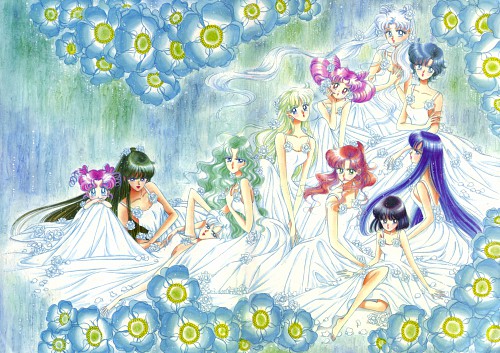
Yelo – The other Senshi do definitely exist in the Japanese version – the American version didn’t change that. And the creator herself has said that Sailors Uranus and Neptune are meant to be seen as a couple. All the art you see in this article is official Japanese art, by the creator.
Well, there are some recognizable about Ronin Warriors and Sailor Moon. We got teenage boys in armor and we got teenage girls in sailor suits. Both teams fight against evil.
I loved everything you wrote, aside from the fact that I disagree that its childish. I’m in my twenties and to this day I still watch Sailor Moon. As a kid ofcourse I watched it dubbed and I became obsessed. I had all the dolls and I was Sailor Moon for Halloween. Even as a child I knew that I never got to see how the series ended due to the fact that the Starlights tranformed and changed genders. I even signed online petitions trying to get it dubbed. As I got older I was always unsatisfied that I never saw the ending. So when I turned 22 and I had a little money I invested in the entire series all 200 episodes and all three movies- subbed. When I saw the Japanese version, I was blown away with how much better it is. To this day I jog on my treadmill and watch Sailor Moon. Being an imperfect, flawed, clumsy girl but having a heart of gold is who I am and who Usagi is. I’ve never related to a charcter from an adult anime like I identify with Usagi. I’m also bisexual so its nice to have a show that actually has bisexual beautiful girls in it. I’ve never read the manga but your article makes me want to. Sailor Moon has much more meaning to it then a childrens cartoon. And that’s the “big deal” about Sailor Moon.
So true. I was dragged from comic shop to comic shop by my dad as a kid, and while I read ninja-turtles and spider-man with my brothers and admired the female x-men, I can still remember the moment I laid eyes on the beautiful artwork on the cover of the individual-issue Sailor Moon comics. I was hooked before I heard of anime, before I saw the cartoon, before the “craze” took hold in the U.S. It satisfied for me everything that my brothers were getting from the ninja turtles comics at the time.
I was there for the first wave of Sailor Moon. I remember being a little girl and watching these glittering strong warriors of beauty and justice vanquish the worst kinds of evil. I remember standing in front of the TV waiting for it to start and singing along to the opening and closing theme songs. I remember putting on my pink cheerleader Holloween costume, pinning a pink paper bow to my chest, and running around pretending to be Chibiusa.
It was the first anime I ever saw, and the first manga I ever had the joy of reading. It has influenced me in immeasurable ways (mostly in leading me to draw anime and always having strong female heroines in the lead roles) and I hold the entire series and all its forms very close to my heart.
If I had never experienced Sailor Moon as a little girl, I would be a very different person now and wouldn’t care two cents about the re-release of the series. I wouldn’t have spent my life idolizing and looking up to the Pretty Guardians and spent years trying to collect all the originally printed manga and freaking out in Fry’s over the re-released version and causing a small scene. Sailor Moon has changed my life in the best way possible, and I personally am very pleased with the re-release of the series for it’s twentieth anniversary.
Speaking of which, I should see if the new volume is out…
Oh you bring back an old love of mine. I was lucky enough to live in a city that was home to Silverwynd, a fan subbing team, so we got some amazing stuff back in the day. But Sailor Moon was never one of them. I used to set the VCR to tape the show when it aired because it was while I was as school. I burned out the timer settings on that VCR and had huge arguments with my mother when she’d turn it off to watch some other tape RIGHT when Sailor Moon was on. I endured some serious ribbing for watching this show, but the romance of it had me by the throat. Thanks for reminding me how much I loved it. I hope I like the new stuff coming out.
Ever get into Fushigi Yugi? Cause that one got me just as bad. ^_^
Sailor Moon, for me, really gave me the foundation to learn how to be strong as I got older. As a transgender male, it was extremely difficult to come to terms with who I was and stop trying to force myself into believing that my body made me a girl despite the sinking feeling that it was all wrong, and I doubt I ever would have come to accept myself as quickly as I did (though it did take years), had I not had the values of believing in oneself, staying strong, and speaking out for what was right embedded in my heart by this beloved series, a series who also offered a collection of strong, brave mentors and role models. All of the characters breaking through the typical gender binaries really encouraged me in a time I couldn’t find it in myself to accept who I was or what I was going through. Sailor Moon also helped me significantly in dealing with others’ perception of me due to the fact that my boyfriend of two years (and best friend of six) are both transgender males and ridiculed for it on both sides(those who think we’re in a lesbian relationship, those who realize we’re both guys in a relationship.) Characters like Uranus (who, as a transman, I looked up to enormously growing up and felt my heart glow for when Neptune said in a scene in the manga that Uranus shared both male and female traits) and Neptune who, though oppressed by censorship and paranoid parental figures, loved so fearlessly and beautifully that it was impossible not to see its depth, characters like FishEye, who, though he or she was often rejected or taunted, continued to dream and aspire and express them self, characters like the Starlights, who broke all rules in regards gender, particularly during the anime (though manga Seiya will always be dear to my heart)… They were all characters who reflected aspects of who I was that I would never be able to accept in myself, but who allowed me to accept and even respect through their brilliance and inspiration. There we also the others. Hotaru, who, though abused, mistreated, and abandoned by so many for her differences, continued to strive to be a good person and to love. Minako, the leader who struggled to live up to the pedestal she had been placed on by her duty to her princess and friends. Rei, whose fierce personality taught me that it was alright to actually speak up for yourself. Makoto, who was often misjudged and seen as a bad person due to childish rumors and misunderstandings, and yet never fell into the persona others had attached to her. Ami, whose quiet demeanor often left her to toil with her emotions and insecurities alone, and yet made her mature. Setsuna, who saw the possibility of doom ever-present on the horizon, and yet continued onward with hope for a better tomorrow. Chibiusa, whose innocence never faltered, and whose love was unconditional and everlasting, even when bittersweet. The Amazon Quartet, whose wish to hold on to their childhood and fear for what dangers becoming an adult held for them led them into darkness in the anime, and finally, Usagi, whose love was never severed by hate or rage, who fought for all, even if it meant her own suffering or even death, whose experiences made her even warmer rather than bitter, who held no bias in her heart even for those who had wronged her, and who taught me that being mature didn’t mean letting go of your inner child. Honestly, I can go on and on, but I know I’m talking too much. My point is that I truly do believe that Sailor Moon played a significant role in making me who I am today, and without it, I’d probably be pretty lost. I love Sailor Moon. I am a transguy, and I am not afraid nor ashamed to proclaim that.
What an amazing comment. Thanks so much for posting that.
I’ve highlighted Alexander’s comment as a post here.
Pingback: ¿Sabías que algunos de los mejores cómics son feministas? | Galo Lara Yépez
im a little late to this, but the new series is out shortly!!! :D
Pingback: THE PROGRESSIVENESS AND LIMITATIONS OF THE ANIME SAILOR MOON, VIS-À-VIS THE STRUGGLE FOR WOMEN’S RIGHTS | Permanent Socialism
Well the first season is childish, but was made for children at that time,as we grow up there is more action in sailor moon. I can not compare it with Xena because it is totally different but I love Xena too and I watch it sometimes. The first season from sailor moon is only about the moon kingdom, the last star season has more auction and dramatically fight and it was not aired in america because it was not for children. They said the new season will be aired worldwide, but I doubt that. the toys that come out are now more for grown up, all pretty make up things. The last I got were sailor Uranus and neptune pens,pluto and saturn pens. adult and boring, but I am a adult now ^^
Sailor Jupiter/makoto/lita is more a boyish scout. she is very good in fighting, and she was transferred to another school because she fighted with boys XD.People were scared with her, but then she meeted usagi.Usagi can be clumbsy but she becanme good friends and discovered that she has female sides too but doesn’t show it,like how pro sailor Jupiter is in cooking
Nice article. I like this series for it what is.
I like the characters (especially Pluto!) & the relationships,
the monster designs & villains, the music (the music is amazing!) etc.
I won’t deny that the series has its ups and down and it does get repetitive at times.
And I don’t like how certain characters get shafted at times.
I’m the kind of boy that spends his time reading through manga scans
of ultra-violent stuff like Exoskull Zero, Devilman, The Guyver, Akira, Berserk,
(series with little to almost no light hearted moments and sorrow stuff)
and when I went into this series I thought “I have to at least check out one
girly anime/manga, so why not go with the most popular girly anime of them all?”
So here’s to Sailor Moon, still bringing in fans and staying strong for 25 years.
Pingback: [Discourse] Dark and gritty reboots of the magical girl genre - Anime Feminist
Pingback: [Discourse] The problem with the dark magical girl genre - Anime Feminist